
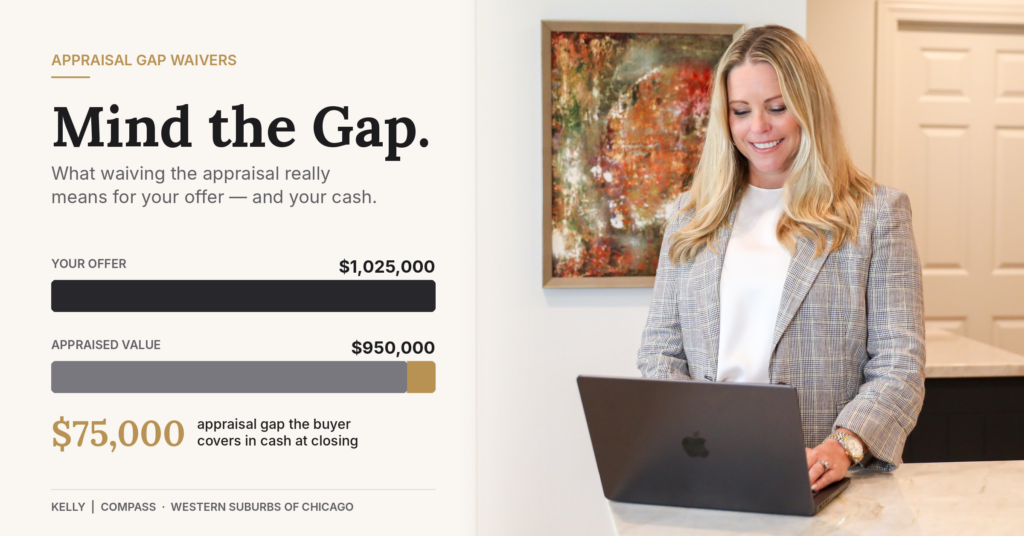
An appraisal gap waiver is a clause in your offer where you agree to cover, in cash, any shortfall between your contract price and the appraised value, up to a set dollar amount. Below that amount, you give up your right to renegotiate or cancel over a low appraisal. In Clarendon Hills, Hinsdale, and Western Springs, where homes are selling at or above list, most buyers size the waiver to the gap their comps suggest. Using the appraisal gap waiver is superior to just picking a number or waiving the appraisal contingency entirely for most buyers.
By Kelly Kirchheimer | November 12, 2026
An appraisal gap waiver is a written promise to the seller: if the appraisal comes in low, I’ll make up the difference in cash, up to this amount, and I won’t use the low number to renegotiate or back out.
Here’s what it looks like in practice. You offer $1,025,000 with a $75,000 appraisal gap waiver. The appraisal comes back at $1,000,000. Your lender bases the loan on $1,000,000, you bring the extra $25,000 to closing, and the seller still gets the $1,025,000 you agreed to.
If the appraisal had come in at $925,000, a $100,000 gap, you’d cover the first $75,000. The remaining $25,000 goes back on the negotiating table.
Three things make this different from other “waivers” you’ll hear about:
It’s not a full appraisal contingency waiver. Waiving the appraisal contingency entirely means you’re on the hook for any gap, no matter how large. A gap waiver has a ceiling, so your worst case has a limit.
It’s not a lender appraisal waiver. Some loans qualify for a program where Fannie Mae or Freddie Mac accepts the value without a full appraisal. That’s the lender’s decision, not something you offer a seller.
It’s paid in cash, on top of your down payment. Your lender only funds against the appraised value. Every dollar of gap coverage comes out of your pocket at closing.
Sellers love an appraisal gap waiver because it takes one of the biggest “what ifs” off their plate. When a seller is comparing five offers, the buyer who says “a low appraisal won’t derail this” often wins, even at the same price.
Why appraisal gaps keep showing up in the western suburbs
You win the bidding war. Your offer beats out four others. Then, two weeks later, your lender calls: the appraisal came in $20,000 under your contract price.
Now you’re choosing between three bad options: losing the house, draining your cash reserves, or asking a seller who has backup offers to take less money.
Buyers in Clarendon Hills, Hinsdale, and Western Springs are running into this constantly right now. Homes have been selling at 101% to 102% of list price with only a couple of days on the market. When several buyers compete for the same house, the winning offer often lands above what recent comparable sales support, and that’s exactly the gap an appraiser is trained to catch.
Inventory is the root of it. Rate lock-in — homeowners sitting on sub-4% mortgages with little reason to sell — has kept supply tight. As of May 2026, Westmont’s detached-home inventory was down roughly 50% year-over-year, and Western Springs was down nearly 57%, with only about 13 homes on the market. With that few options, winning offers climb faster than closed sales can keep up, and appraisals lag behind.
That’s why the appraisal gap waiver has become one of the most common terms I see in competitive offers, right alongside the decision of whether to waive the inspection in a Clarendon Hills bidding war.
How to size your appraisal gap waiver
Most buyers I work with land somewhere between $5,000 and $25,000 in gap coverage, or roughly 3% to 5% of the purchase price. But the right number isn’t a formula. It comes from the comps.
The mistake I see most often is picking a number that sounds competitive instead of one grounded in data. Here’s the better approach:
Start with the comps, not the list price. If recent closed sales support a value around $810,000 and you’re planning to offer $850,000, your realistic exposure is closer to $40,000, not whatever number feels “safe.”
Check your cash before you commit. Your gap ceiling needs to be money you can actually access at closing, on top of your down payment and normal closing costs. If you commit to $20,000 and don’t have it liquid, you’ve put your earnest money at risk.
Decide how much risk you’ll carry. A higher ceiling makes your offer stronger to a seller. A lower one protects your cash. There’s no universal right answer. It depends on how much you want this specific house versus how much flexibility you need to keep.
Your exact number depends on how far above the comps your offer sits, what you have liquid, and how the other contingencies in your offer are shaping up. That’s exactly the kind of read a current market analysis is built for.
What happens if the gap is bigger than your waiver
If the appraisal comes in lower than your waiver covers, and you kept your appraisal contingency in place, you generally have three paths:
Ask the seller to split the difference. This is the most common resolution. The seller lowers the price partway, and you cover the rest in cash. A $20,000 overage split evenly is a $10,000 price reduction and $10,000 out of your pocket.
Request a reconsideration of value. If your agent can supply stronger, more recent comparable sales than the appraiser used, the lender can request a formal review. It doesn’t always change the number, but it’s worth doing when the comps genuinely support it.
Walk away. With your appraisal contingency intact, you can cancel and keep your earnest money. This only works if you didn’t waive the contingency to make your offer more competitive in the first place.
Why overpaying to win is riskier than it feels
It’s easy to get swept up in a bidding war and stretch past what the data supports just to win. But research on bidding-war outcomes has found that buyers who win competitive bidding situations tend to see weaker returns over time than buyers who didn’t. The thrill of winning doesn’t always translate into a good long-term outcome.
That doesn’t mean you should walk away from every competitive offer. It means the number you put in your appraisal gap waiver should come from real comps and real cash math, not adrenaline.
Before you set your number, ask yourself:
Do I know what the comps actually support, or am I guessing off the list price?
Do I have the cash, separate from my down payment, to cover the number I’m about to commit to?
Am I keeping some form of appraisal contingency, or waiving it entirely?
Is this the house I’m willing to stretch for, or the house I’m afraid to lose?
Those last two aren’t the same thing. In a market this competitive, it’s worth knowing the difference before you’re staring at a low appraisal with a five-day clock running.
Frequently Asked Questions
What is an appraisal gap waiver?
An appraisal gap waiver is an offer term where the buyer agrees to pay, in cash, the difference between the contract price and a lower appraised value, up to a set dollar amount. Within that amount, the buyer gives up the right to renegotiate or cancel because of the appraisal. It’s also sometimes called appraisal gap coverage or an appraisal gap guarantee.
Is an appraisal gap waiver the same as waiving the appraisal contingency?
No. An appraisal gap waiver caps your exposure at a specific amount, like $15,000. Waiving the appraisal contingency entirely means you’re responsible for the full shortfall no matter how large, with no right to walk away over a low appraisal.
How much appraisal gap coverage should I offer?
Most buyers in competitive markets like Clarendon Hills, Hinsdale, and Western Springs offer between roughly 3% to 5% of the purchase price. The right number should be based on how far your offer sits above recent comparable sales, and on the cash you actually have available beyond your down payment.
What happens if I don’t include an appraisal gap waiver and the appraisal comes in low?
If you kept an appraisal contingency, you can typically renegotiate the price with the seller or walk away and keep your earnest money. Without a contingency or a gap waiver, you’d need to cover the entire shortfall in cash or risk losing the deal and your earnest money.
Can the seller and I split the appraisal gap?
Yes, and it’s one of the most common resolutions. If the gap is $20,000, a seller might lower the price by $10,000 while you cover the other $10,000 in cash, a compromise that keeps both sides closer to whole.
An appraisal gap waiver lets you compete hard in Hinsdale and the surrounding western suburbs without handing over a blank check. The key is a number built on your comps and your cash reserves, not a guess. That’s exactly what I walk buyers through before they ever submit an offer.
Ready to talk through your next offer in the western suburbs? Connect with Kelly Kirchheimer for your Western Suburbs real estate needs in Chicagoland: https://kellykhomes.com/contact/
About Kelly Kirchheimer Kelly is a Compass real estate agent with over a decade of experience serving Clarendon Hills, Hinsdale, Western Springs, and the greater western Chicago suburbs. Before real estate, she spent years in enterprise technology sales and holds an MBA in Entrepreneurship — a background that shapes how she approaches pricing strategy, negotiation, and client advocacy. Kelly specializes in helping families navigate moves in and out of the western suburbs, with deep knowledge of the area’s top school districts and Metra commuter access.